Herbal Tea and Sweet Soups in Guangzhou: Liangcha, Tong Sui
Last checked October 19, 2026 against official sources. How we check

Quick answer
Liangcha (凉茶) is a Cantonese herbal drink, bitter or sweet, sold at street-side shops and chains. Tong sui (糖水, “sugar water”) is a sweet dessert soup such as red bean, black sesame or double-skin milk. Tongfu Road in Haizhu and Jianggao Tongshui Street in Baiyun are two places named in official or state-media pages.
Key facts
| Price | No dated price found; check the board or the app menu before you order |
|---|---|
| Heritage status | 凉茶 is on China's first national intangible heritage list (2006), Guangdong |
| Ask for | 凉茶 (herbal tea), 糖水 (sweet soup), 不要太甜 (not too sweet) |
| Allergy and diet | Many tong sui contain milk, egg or nuts; some do not suit vegans |
What is liangcha?
Liangcha (凉茶, literally “cooling tea”) is a herbal drink from Guangdong. Despite the name it is not made from tea leaves. The national listing at ihchina.cn says people in Guangdong, Hong Kong and Macau developed it to suit their local climate, using traditional Chinese medicine ideas. The listing presents it as an everyday drink with its own traditional terminology.
This site makes no health claims. If you are pregnant, have a health condition or take medication, ask a doctor before you drink herbal tea.
Why is it a heritage item?
Liangcha was added to China’s first national list of intangible cultural heritage in 2006, under Guangdong Province, category traditional craftsmanship, project code Ⅷ-89 (ihchina.cn serial number 439). The entry traces the tradition to Ge Hong, a physician of the Eastern Jin dynasty who came to Lingnan in 306 CE and studied the region’s epidemic diseases. Later local physicians added to his work. It lists 54 formulas from 16 brands, among them Wong Lo Kat (王老吉), Sheung Ching Yam and Pak Wan Shan (白云山). The entry says tea shops closed during the Cultural Revolution and many items were lost, while the tradition survived in Hong Kong and Macau.
What kinds of liangcha will you find?
China Daily’s government channel says Guangzhou herbal teas fall into two groups: sweet teas and bitter teas. It names Bansha Liangcha (癍痧凉茶, per Newsgd) as a bitter black tea, and the brands Huang Zhenlong (黄振龙), Gengtiangong and Linshi. It also repeats a local saying that Guangzhou has more herbal tea shops than rice shops. The article does not list the herbs.
What this means in practice:
- A counter selling bottled or cup liangcha is easy to find. You can usually point at what you want.
- Ask for the milder one if you are unsure, and take a small first sip. Bitter ones are meant to taste bitter.
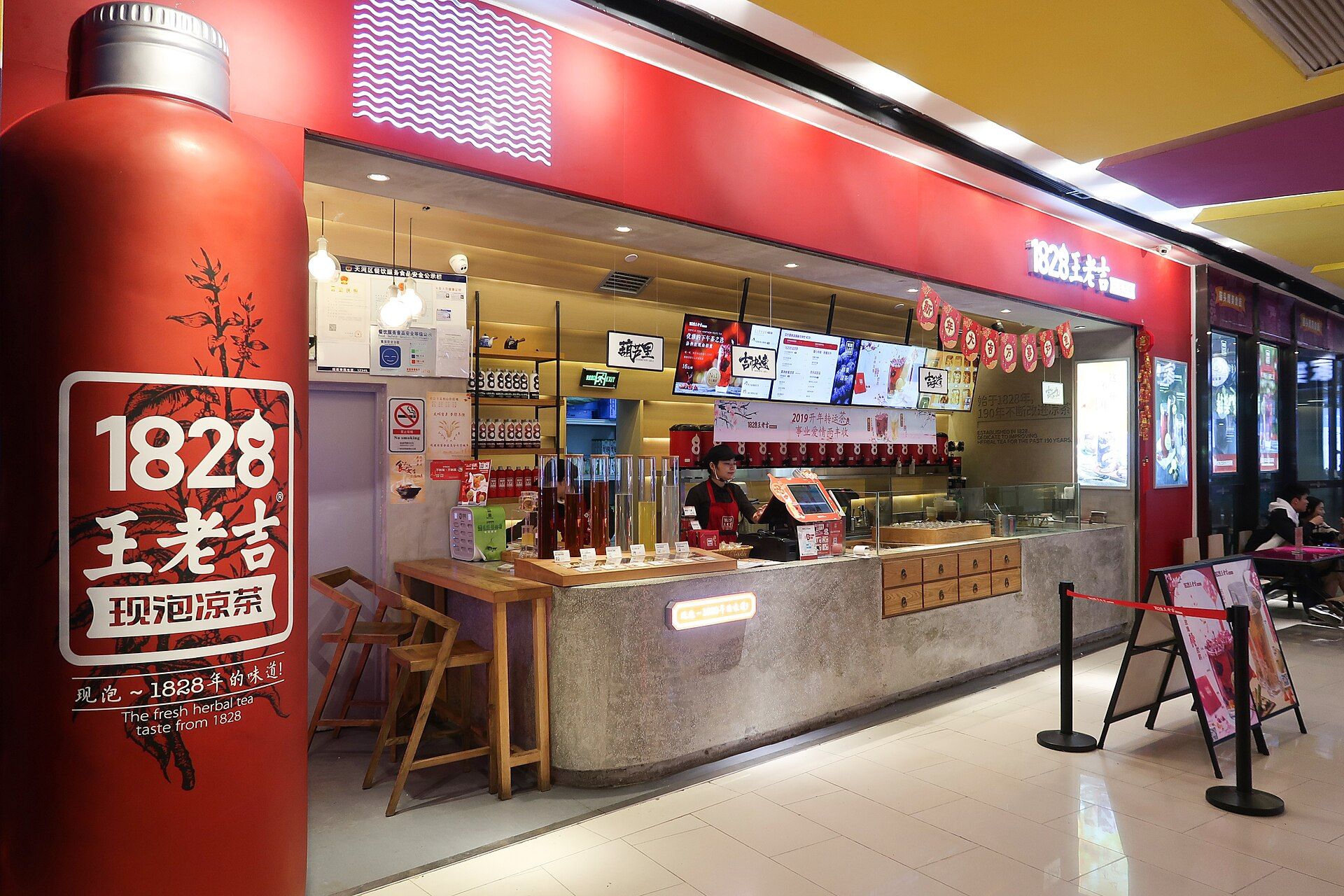
- Chains also sell a freshly brewed cup. The cover photo shows a 王老吉 shop counter in a Guangzhou mall, captioned 现泡凉茶 (freshly brewed herbal tea).
What is tong sui?
糖水 (tángshuǐ, “sugar water”) is the Cantonese word for sweet soups and puddings. Wikipedia describes it as a sweet soup eaten as a dessert, usually at the end of a meal, and in the narrow sense soupy desserts from the Lingnan region. It can be served hot or cold, depending on the shop and the dish.
| Dish | Chinese | What it is, per Wikipedia | Watch for |
|---|---|---|---|
| Red bean soup | 红豆汤 | Red beans and sugar | Usually plant-based |
| Mung bean soup | 绿豆汤 | Mung beans and sugar | Usually plant-based |
| Black sesame soup | 芝麻糊 | Ground black sesame, rock sugar and water | Sesame allergy |
| Sago soup | 西米露 | Pearl tapioca, coconut, evaporated milk | Contains milk |
| Mango pomelo sago | 杨枝甘露 | Mango, pomelo, sago, coconut milk, milk | Contains milk |
| Double-skin milk | 双皮奶 | Milk-based pudding | Contains milk |
| Steamed egg custard | 炖蛋 | Egg | Contains egg |
| Sweet almond / walnut / peanut soup | 杏仁糊 / 核桃糊 / 花生糊 | Ground nut paste with sugar | Nut allergy |
| Tofu pudding | 豆腐花 | Soy milk, coagulant, syrup | Soy |
| Tortoise jelly | 龟苓膏 | Listed by Wikipedia as made with turtle | Not vegetarian |
| Ching bo leung | 清补凉 | Mung beans, pearl barley, jujube, fruit, syrup and ice | Sometimes milk |
Wikipedia’s vegan notes are inferred from ingredients and its own list says sweeteners and coagulants can differ between shops. Ginger milk curd (姜撞奶) is also common and is milk-based. For strict diets, the halal and vegetarian guide has more.
Where can you find herbal tea and tong sui?
These are the places named by official or state-media pages. Check hours on a map app, because the older figures may be out of date.
Jianggao Tongshui Street, Baiyun
The Baiyun District government’s English page, dated March 16, 2026, presents Jianggao Tongshui Street (江高糖水街) as a Cantonese dessert landmark with arcade buildings and more than 10 long-established dessert shops. It lists double-skin milk, red bean paste, black sesame paste and tortoise jelly among the traditional items. The page gives no opening hours or address, so look it up on a map app in Chinese before you go.
Tongfu Road, Haizhu
Newsgd, a Guangdong state-media site, wrote on July 12, 2019 that Tongfu Road is a traditional arcade street where time-honoured dessert, soup and herbal tea shops sit beside small restaurants. It gave the way in as Exit D of the Second Workers’ Cultural Palace metro station, at the start of Tongfu East Road. Its examples, with 2019 hours that may have changed:
- Fenfang Dessert: open 06:30–23:00, known for water-chestnut syrup, a sweet soup with egg drop and water-chestnut cubes.
- Wong Chun Loong Herbal Tea (黄振龙): open 10:00–22:00, selling herbal teas, including the bitter Bansha tea.
Xihua Road, Liwan
Goldthread’s July 17, 2019 article lists a black sesame soup shop, 芝麻糊世家, at 383 Xihua Road, where the sesame is hand-crushed and cooked for 20 minutes. Xihua Road is also covered in the street food guide.
How do you order and pay?
Point at the board, or use the table QR code if the shop has one. Say 不要太甜 (búyào tài tián) to ask for less sugar and 热的 (rè de) or 冰的 (bīng de) for hot or iced. Set up Alipay or WeChat Pay before you go; the payment guide explains how. For tea itself rather than herbal tea, see the Cantonese tea culture guide. For late hours, the nightlife guide is the place to start.
A simple plan for a first visit: try one sweet liangcha and one hot or cold tong sui, such as red bean or black sesame, and compare them with your usual drinks and desserts. No dated source gave a price for either.
Prices were not available from dated, reliable sources, so none are quoted here.
Traps and how to avoid them
- Expecting a sweet drink
Guangzhou herbal teas are divided into sweet and bitter types, says China Daily. If you want mild, ask for the sweet one and taste a little first.
- Treating herbal tea as medicine
Nothing here is medical advice. The heritage listing describes everyday drinking, but if you are pregnant, have a medical condition or take medication, ask a doctor before drinking herbal tea.
- Assuming a dessert is vegan or nut-free
Double-skin milk, steamed milk custard and ginger milk curd are milk-based. Egg tong sui contains egg. Almond, walnut and peanut soups contain nuts. Ask, and show the Chinese if you have an allergy.
FAQ
What is Cantonese herbal tea?
凉茶 (liángchá) is a herbal drink that people in Guangdong, Hong Kong and Macau developed to suit the local climate and environment, according to the national heritage listing. It is made from Chinese medicinal herbs. It is not tea leaves.
Does herbal tea have health benefits?
This guide makes no health claims. The heritage listing describes liangcha as a traditional everyday drink. Ask a doctor if you are pregnant, have a condition or take medication.
What does tong sui mean?
糖水 means “sugar water”. Wikipedia describes it as a sweet soup served as a dessert, usually at the end of a Chinese meal.
Is tong sui vegan?
Some are, some are not. Wikipedia's ingredient list for red bean, mung bean and black sesame soups contains no animal products, and double-skin milk, egg tong sui and mango pomelo sago as containing milk or egg. Shops vary, so ask.
What are the main types of tong sui?
Common ones are red bean soup (红豆汤), mung bean soup (绿豆汤), black sesame soup (芝麻糊), sago soup (西米露), double-skin milk (双皮奶) and tofu pudding (豆腐花). The full set is long, and each shop has its own.
Sources
- China Intangible Cultural Heritage (ihchina.cn): 凉茶, first batch 2006, Guangdong
- China Daily (government channel): Liangcha (2018)
- Baiyun District government: Jianggao Tongshui Street (March 16, 2026)
- Newsgd: Guangzhou's food street is a must-see (Tongfu Road, July 12, 2019)
- Wikipedia: Tong sui
- Goldthread: 5 must-try street foods on Guangzhou's Xihua Road (July 17, 2019)
Spotted something out of date? Tell us and we will check it.