Guangzhou Airport Transit: Transfers, Bags, Visa Rules
Last checked October 23, 2026 against official sources. How we check

Quick answer
Follow the Transfer signs to your transfer counter. At Terminal 2 it is on level 2 for international-to-international and on level 1 for international-to-domestic, after border entry. Staying airside within 24 hours with an onward ticket needs no visa. A connection that enters China needs visa-free status, a visa or a temporary entry permit.
Key facts
| Terminals | T2 and T3 only; T1 closed May 7, 2026 |
|---|---|
| Minimum connection | 60 minutes at China Southern's T2 hub, per the airline; the airport publishes none |
| International to international | Can stay airside (China Southern, T2) |
| International to domestic | Border entry inspection first, so you need an entry right |
| Transfer desk, T2 | Level 1 for domestic connections, level 2 for international ones (China Southern) |
| Help | China Southern transfer hotline (0086) 20 8612 4008; airport 020-96158, 24 hours |
Next steps
Which kind of connection do you have?
Your connection type decides everything: whether you pass immigration, whether you see your bags, and which counter you use. The flows below are China Southern’s, for its Terminal 2 hub: the only complete official ones we found.
| Connection | Enter China? | First stop and bags (T2) |
|---|---|---|
| International to international | No, if you stay in the airport | International transfer counter, level 2. Through ticket: straight to the gate |
| International to domestic | Yes, border entry | Transfer counter, level 1. Collect and re-check bags, unless you hold a connecting boarding pass and bag tag |
| Domestic to international | No new entry; exit control | Transfer counter, level 1 without a through ticket. Through ticket: bags checked through |
Baiyun Airport’s own transfer page shows its flows as images, in Chinese. Its tabs still name T1 and none names T3, and most of its flow images were uploaded in September 2024.
International to international: staying airside
This is the one connection that can stay inside the restricted area. The steps at Terminal 2, from China Southern’s flow:
- Get off the plane and follow the signs for transfers.
- Pass the customs area.
- Go to the international-to-international transfer counter on level 2 and complete the transfer formalities.
- Pass customs and security again.
- Take the lift to level 3 and go to the international departure waiting hall.
- Go to your gate.
With a through ticket and a connecting boarding pass, go straight to the connecting gate (China Southern).
International to domestic: you enter China
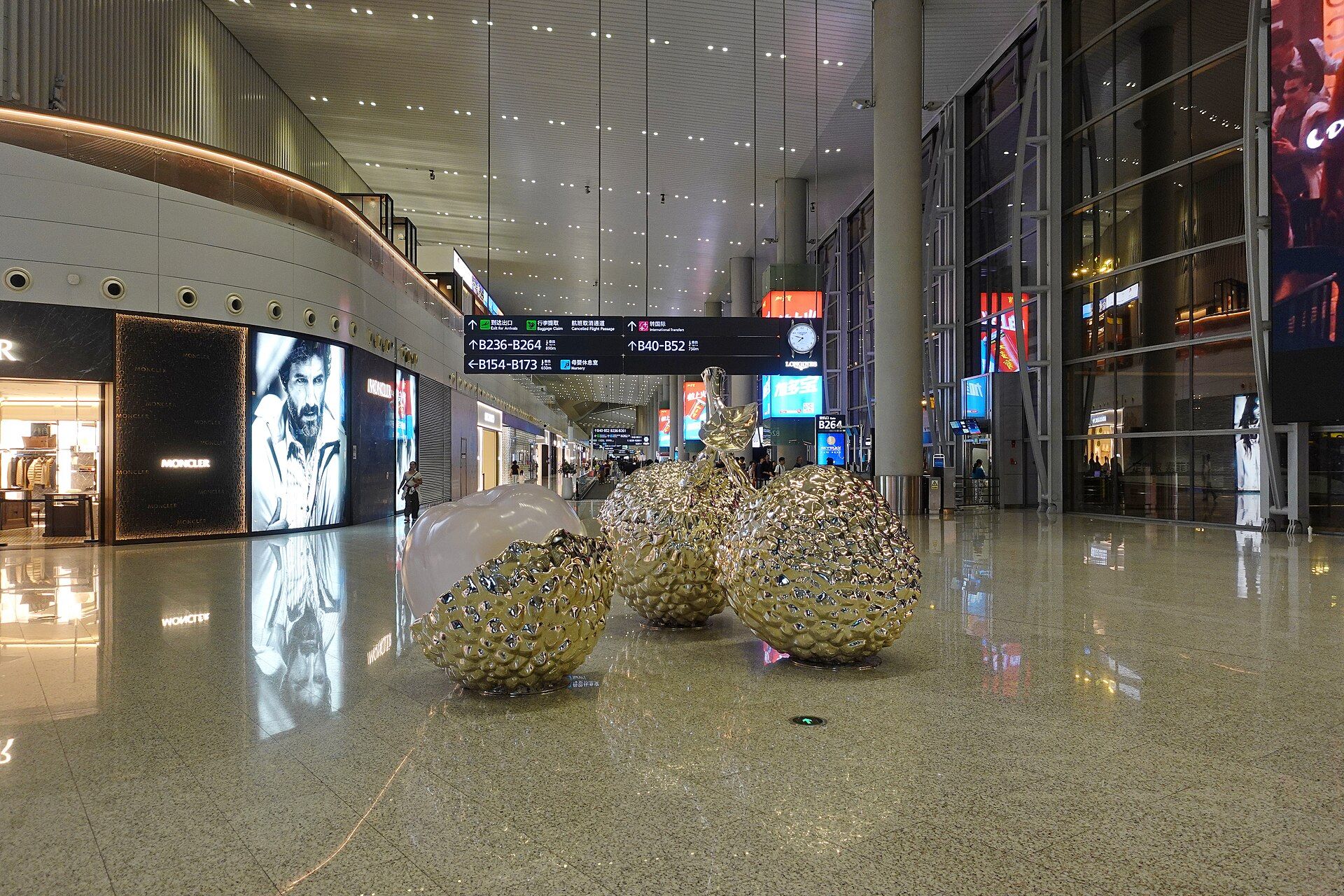
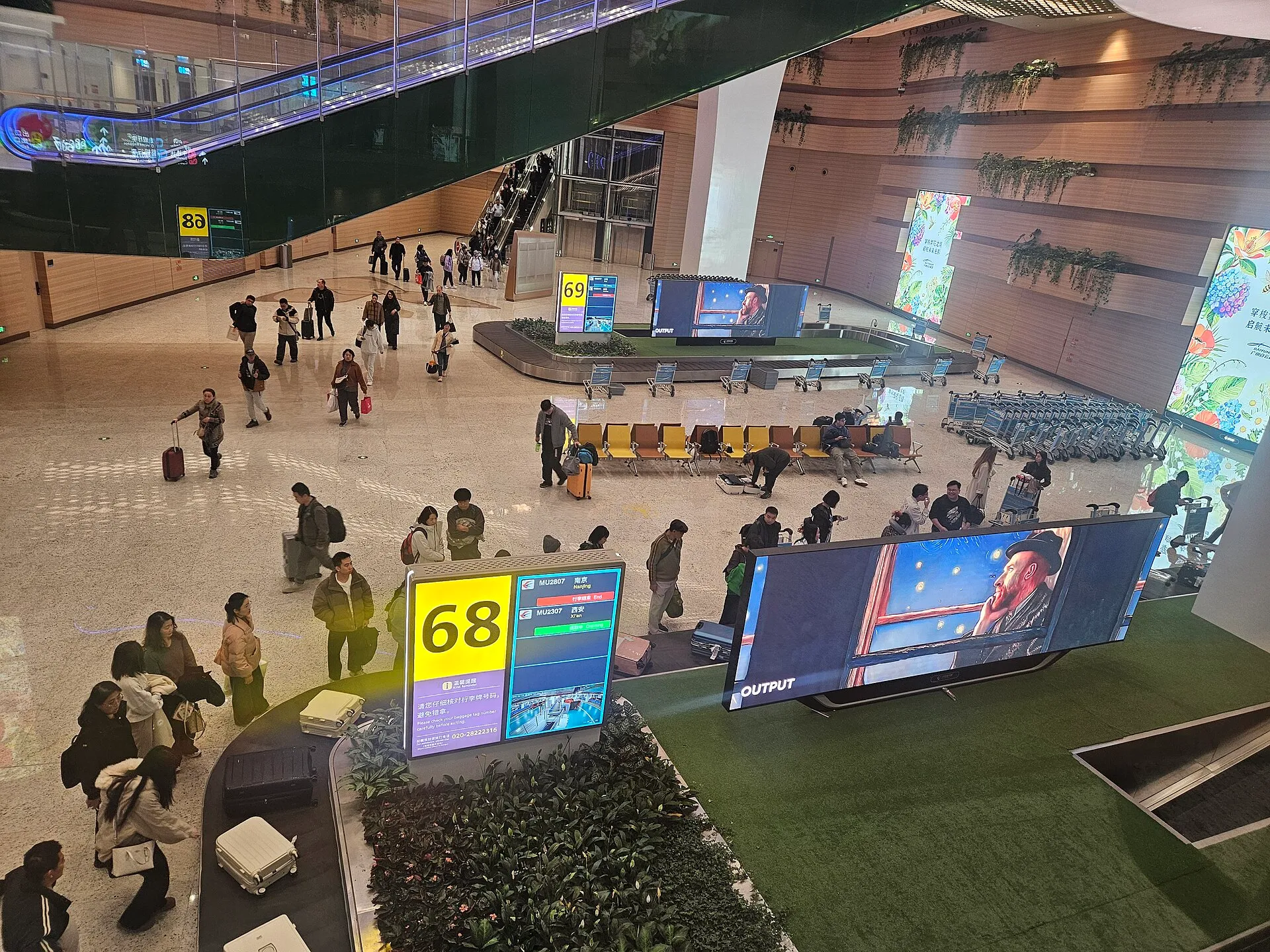 Photo: Sun8908 · CC BY-SA 4.0 Details
You pass border entry inspection, so you are entering China. Check your passport in the visa-free checker first.
With a China Southern through ticket and connecting boarding pass:
- Get off the plane and go through customs and border entry inspection.
- Wait in the waiting area with your connecting boarding pass.
- Go through customs and security.
- Walk to your domestic gate.
Everyone else:
- Go through customs and border entry inspection.
- Take the lift to level 1 and collect your bags.
- Go through customs, then turn right before the arrivals hall.
- Complete the transfer formalities and re-check your bags at the international-to-domestic transfer counter on level 1.
- Take the lift to level 2 and pass security at the front of the cross-shaped corridor.
- Go to your domestic gate.
Domestic to international
You arrive on a domestic flight and leave the country. China Southern’s flow has two versions:
With a through ticket:
- Get off the plane. If you do not hold the connecting boarding pass, go to the transfer counter first.
- Walk through the cross-shaped corridor on level 2 and the domestic-international aisle.
- Pass departure security on level 3.
- Pass customs, then border exit inspection.
- Wait in the international departure hall, then go to your gate.
Without a through ticket:
- Collect your bags from the level 1 carousel.
- Check in and drop your bags at the transfer counter on level 1.
- Take the escalator to level 2 and pass security before the cross-shaped corridor.
- Follow the same route as above: corridor, domestic-international channel, level 3 security, customs, border exit inspection, gate.
Overweight fees are paid at the level 3 check-in counters.
Which terminal, T2 or T3?
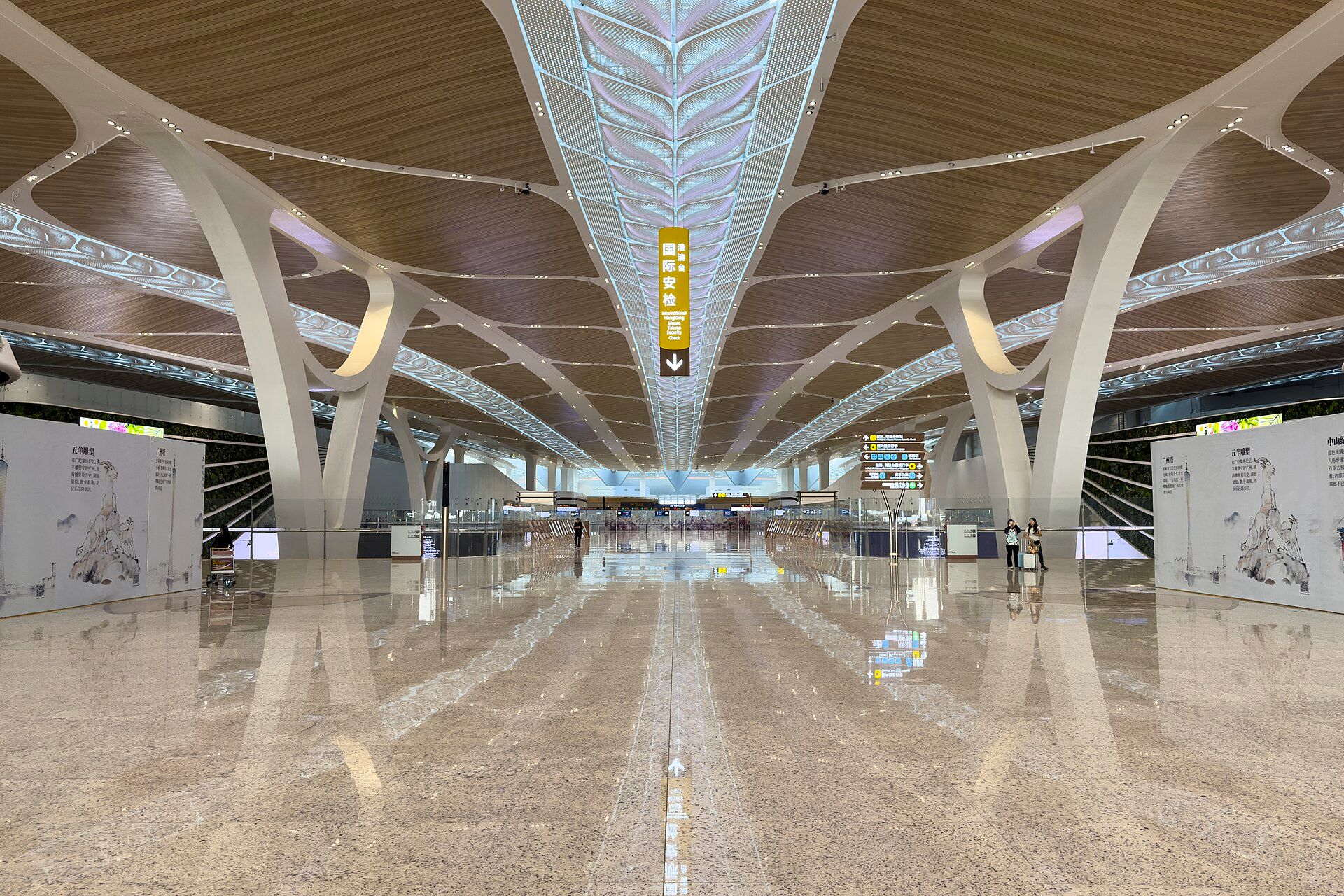
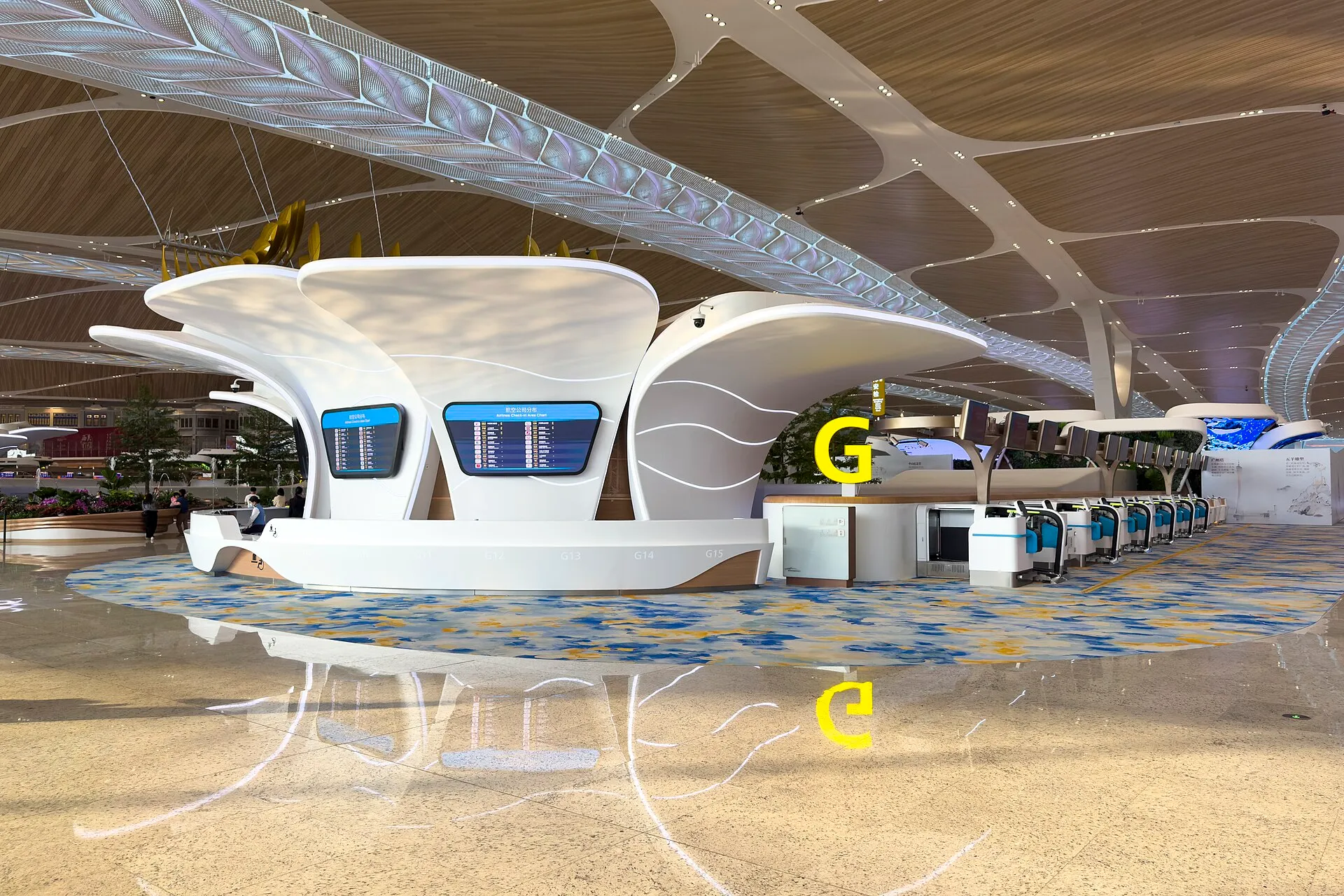 Photo: Tim Wu · CC BY-SA 4.0 Details
Every passenger flight uses Terminal 2 or Terminal 3. T1 closed to passengers on May 7, 2026. The Baiyun terminals guide lists which airlines use which terminal and how to move between them. In short, China Southern and its partners are at T2, and most other airlines, including Air China, China Eastern, Hainan, Cathay Pacific and Emirates, are at T3.
- One terminal. China Southern’s flows above apply at T2. For T3 we found no airport page that names counter locations.
- Two terminals. The airport runs a free 24-hour shuttle bus for transfer passengers between T2 and T3.
- At T3 (ANA’s flights). For connections on airlines at T2, go to the International Transfer Counter on the arrivals floor. With bags checked through, you need not collect them; take the inter-terminal bus, and staff guide you to the stop. For domestic connections, go to the domestic transfer counter on level 1 after arrival formalities and bag pickup, according to ANA’s Guangzhou guide.
Do you have to pass immigration?
You pass immigration if you leave the restricted area, and on any international-to-domestic connection. In practice:
- Staying airside, international to international. No entry. You stay in the restricted area.
- International to domestic. Border entry inspection is part of the flow.
- Leaving the airport, even for a hotel night. You enter China. See the layover guide and the transit hotels guide.
For the entry rights themselves, check which applies to you:
- 30-day visa-free entry, for passports on the list. See the 30-day visa-free guide.
- 240-hour visa-free transit, with a confirmed onward ticket to a third country or region. See the 240-hour transit guide. Hong Kong, Macao and Taiwan count as onward destinations.
- A temporary entry permit for a transit under 24 hours. With an interline ticket to a third country or region and a transit within 24 hours, you need no visa if you stay in the port. To leave, apply to the border inspection station for a temporary entry permit (NIA interpretation, March 29, 2021).
The permit can be refused for an entry ban, a passport valid for under 3 months, or recent illegal entry, residence or work, among other reasons (NIA; its English page is for reference, the Chinese version is authoritative).
Follow the NIA and the visa-free checker, not China Southern’s 24-hour permit page: it still describes a 144-hour scheme for 54 countries, which is out of date.
For the arrival card: passengers who transit directly within 24 hours without leaving the port’s restricted area are exempt, according to the NIA. If you enter China, see the arrival card guide.
How much connection time do you need?
Allow at least 60 minutes at the Terminal 2 hub, China Southern’s minimum connection time, per the airline. It does not say which connection types or fares this covers. Baiyun Airport publishes no minimum on the pages we read.
The 60 minutes is an airline minimum, not a promise for every ticket. If you enter China or change terminals, the steps above take longer. Book longer connections when the second flight is on a separate ticket.
Is there a transit lounge or rest area?
Ask your airline whether your ticket includes lounge access. China Southern’s Terminal 2 transit lounge is under construction, with no opening date (China Southern’s transit lounge page).
Terminal 2 has paid hourly rest rooms, at international arrivals Gate 53 and beside the art gallery on domestic departures level 4, plus a free overnight rest area (Guangzhou Transport Bureau, June 18, 2025). The notice does not say whether any of them is inside the international transit area, so on an international-to-international connection do not count on them. More in our airport hotels guide.
What if you miss the connection?
If you miss a China Southern connection at its hub (China Southern’s misconnection page):
- Go to China Southern’s transfer counter at Terminal 2 to change your ticket.
- If the new connection is over 4 hours away, you get free meals in the dining periods.
- If China Southern caused the miss and the new connection is over 8 hours away, you get free lodging.
An international-to-international passenger needs an entry permit and entry formalities before a hotel can be arranged. Hotels are outside the restricted area. China Southern’s transfer hotline, (0086) 20 8612 4008, runs 24 hours. The airport’s 24-hour line is 020-96158.
What we could not confirm
- Transfer counter locations at T3. No airport or city page gives them. ANA’s page is the only official statement we found.
- The current China Southern pages. They are undated and describe T2 only.
- JAL’s Guangzhou page. It returned an access error when we read it, so we did not use it.
- Minimum connection time beyond China Southern’s 60 minutes. Not published by the airport.
- Queue times at transfer counters, security and border control. Not published.
Traps and how to avoid them
- Trusting a transfer page that still says T1 or 144 hours
Terminal 1 closed on May 7, 2026, and China Southern's transit pages still describe a 144-hour scheme for 54 countries. The current rule is 240 hours. Use the pages below for the order of steps, and confirm counters with your airline.
- Assuming an international-to-domestic connection stays airside
China Southern's flow for this connection includes border entry inspection. You are entering China, so you need visa-free entry, a visa or a temporary entry permit before you fly.
- Assuming bags are always checked through
Through-checking depends on the airline and ticket. If you pass border entry, you must pick up your bag even when the tag shows your final destination, according to ANA. Ask at your first check-in.
- Planning a T2 to T3 connection like a same-terminal one
If your two flights use different terminals, you also need the free shuttle bus between T2 and T3. Our terminals guide gives its times.
FAQ
Do I need a visa to transit through Guangzhou Baiyun Airport?
Not if you stay inside the restricted area. The NIA says foreigners with an interline ticket to a third country or region, who transit within 24 hours and do not leave the port, need no visa. If you leave the port you need a temporary entry permit or another entry right. An international-to-domestic connection includes border entry, so plan for an entry right.
Is there a transit lounge or rest area at Guangzhou Baiyun?
Not one described as being in the international transit area. China Southern's Terminal 2 transit lounge is under construction, with no date, according to China Southern. A Guangzhou Transport Bureau notice of June 18, 2025 lists paid hourly rest rooms in T2, at international arrivals Gate 53 and on domestic departures level 4, and a free overnight rest area. Ask your airline about lounge access.
How long should my connection be at Guangzhou?
At least 60 minutes at China Southern's Terminal 2 hub, per the airline. It does not say which connections or fares that covers, and Baiyun Airport publishes no figure, so use the longer of the airline's minimum and the time your ticket allows.
Where is the transfer desk at Guangzhou airport?
At Terminal 2, the international-to-international counter is on level 2, and the international-to-domestic and no-through-ticket domestic-to-international counters are on level 1 (China Southern). At Terminal 3, an international transfer counter is on the arrivals floor and a domestic one on level 1 (ANA).
Do I need to collect my bags when connecting in Guangzhou?
It depends on the airline and the flow. Domestic-to-international passengers on China Southern can check bags through at the start, and international-to-domestic passengers with a connecting boarding pass and bag tag get staff help (China Southern). Other passengers collect and re-check. Confirm with your first airline.
Do I need an arrival card to connect at Guangzhou?
Not if you transit directly within 24 hours without leaving the port's restricted area, according to the NIA. If you enter China, see our arrival card guide.
Sources
- Consulate General of China in Guayaquil: Ecuadorian ordinary passports visa-exempt for up to 30 days, tourism or family visits (November 21, 2025, in Spanish)
- Embassy of China in Ecuador: Ecuadorian ordinary passports need no visa for up to 30 consecutive days (February 12, 2026, in Spanish)
- Embassy of China in Sweden: FAQs on Visa-free Entry into China (Ministry of Foreign Affairs text, updated May 25, 2026)
- Ministry of Foreign Affairs (China Consular Service): Mutual Visa Exemption List, July 2026
- National Immigration Administration: Visa-free transit policy (57 countries, 65 ports)
- National Immigration Administration: 240-hour visa-free transit policy interpretation
- National Immigration Administration: Kyrgyzstan and Vietnam added to 240-hour transit and Hainan visa-free entry
- MTR High Speed Rail: 240-hour visa-free transit (Hong Kong, Macao and Taiwan as onward destinations)
- Consulate General of China in Barcelona: visa-free measures summary (online arrival card, Hainan)
- National Immigration Administration: NIA Launches 10 New Measures to Support Expansion of Opening-up (online arrival card), November 3, 2025
- National Immigration Administration: Beware of Fraudulent Websites for Arrival Card Filling (free of charge), December 5, 2025
- Shanghai government (source: National Immigration Administration): China launches online arrival card for international travelers, with the seven exempt groups, November 20, 2025
- Consulate General of China in Toronto: visa-exempt cases (Greater Bay Area and Hainan tour groups, cruise groups)
- Xinhua: China extends visa-free entry for Russian ordinary-passport holders to December 31, 2027 (May 20, 2026, in Chinese)
- Embassy of China in Japan: notice extending unilateral visa-free entry to December 31, 2026 (November 7, 2025, in Chinese)
- Xinhua: China–Thailand mutual visa exemption in force, 30 days per entry and 90 days in any 180 days (March 2, 2024, in Chinese)
- Xinhua: China–Thailand agreement unaffected by Thailand's September 15, 2026 changes (September 2, 2026, in Chinese)
- China Southern: Guangzhou Terminal 2 hub, international to domestic transit flow (undated, read October 23, 2026)
- China Southern: Guangzhou Terminal 2 hub, domestic to international transit flow (undated, read October 23, 2026)
- China Southern: Guangzhou Terminal 2 hub, international to international transit flow (undated, read October 23, 2026)
- China Southern: Guangzhou Terminal 2 hub, service commitments (60-minute minimum connection time, transfer counter, hotline)
- China Southern: Guangzhou hub baggage service
- China Southern: Guangzhou hub flight misconnection guide
- China Southern: Guangzhou hub transit lounge (under construction, undated)
- Baiyun Airport: transfer guide (Chinese; rendered October 23, 2026, text dump in our research notes)
- China Southern: 24-hour stay permit page (still describes the 144-hour scheme for 54 countries; read October 23, 2026)
- Baiyun Airport: moving between terminals (24-hour shuttle)
- ANA: Guangzhou Baiyun airport guide, T3 arrivals and connections (undated, read October 23, 2026)
- NIA English: interpretation of 24-hour visa-free transit (March 29, 2021)
- Guangzhou Transport Bureau: Baiyun Airport overnight rest areas and paid hourly rest rooms (June 18, 2025)
- Guangzhou government: getting to Baiyun Airport T3 after T1 airlines moved (May 2026)
Spotted something out of date? Tell us and we will check it.